
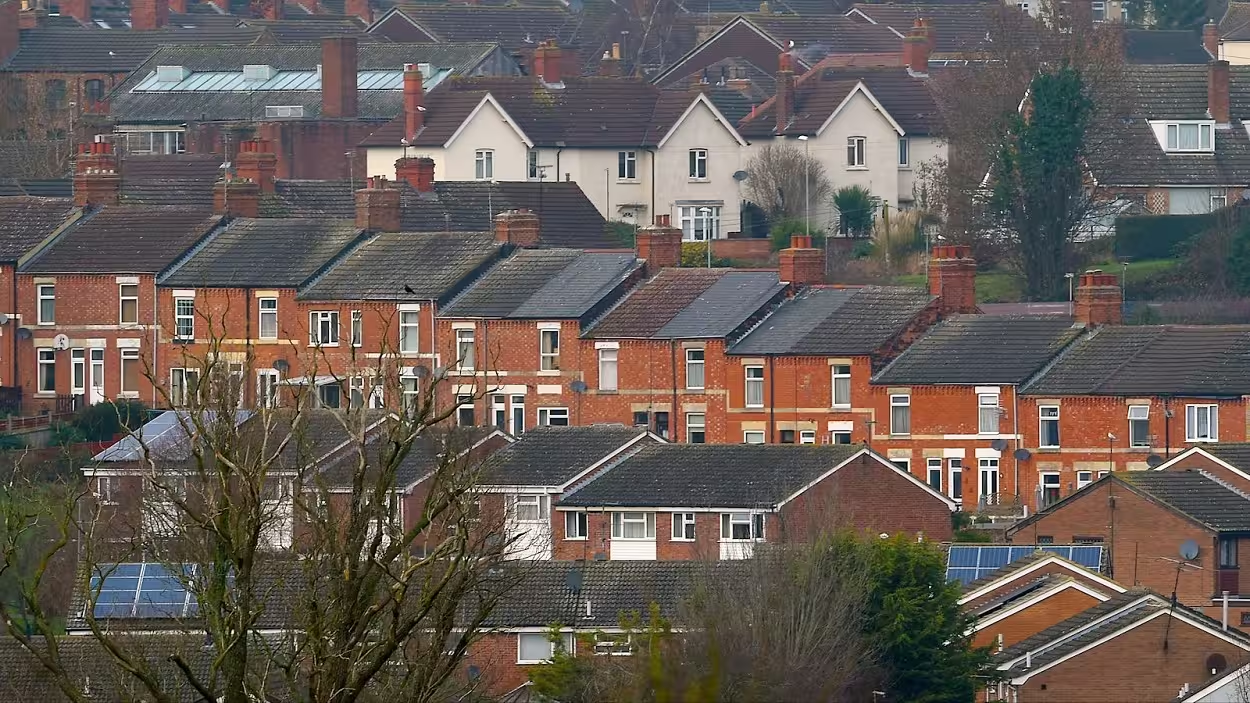
The UK housing and mortgage market is facing renewed instability in 2026, largely driven by the global economic shock triggered by the Iran war crisis. Rising energy prices, inflationary pressures, and financial market volatility have combined to create a challenging environment for homeowners, buyers, and lenders alike.
What began as a geopolitical conflict has quickly translated into higher borrowing costs and weakening housing confidence across Britain.
Rising Mortgage Rates and Borrowing Costs
One of the most immediate impacts of the Iran war has been a sharp increase in mortgage rates. The conflict has disrupted global energy supplies, pushing up oil and gas prices and, in turn, inflation.
As inflation expectations rise, financial markets anticipate tighter monetary policy. This has led to a rapid repricing of mortgage products. Average two-year fixed mortgage rates have jumped from around 4.83% to nearly 5.84% within a month.
Lenders have responded by withdrawing a significant number of mortgage deals due to uncertainty. Reports suggest that thousands of products have disappeared from the market, limiting options for borrowers and increasing costs for new buyers.
Impact on UK Households
The increase in mortgage rates is already placing financial strain on households. The Bank of England has warned that an additional 1.3 million households could face higher mortgage payments as a direct consequence of the war-driven economic shock.
By 2028, the total number of households dealing with elevated mortgage costs could rise to over 5 million.
For many families, this comes on top of the ongoing cost-of-living crisis, where wages have struggled to keep pace with rising prices. The result is reduced disposable income, higher financial stress, and increased risk of mortgage arrears.
Housing Market Slowdown and Buyer Confidence
Although UK house prices showed short-term resilience—with a monthly rise of 0.9% in March 2026—the broader outlook is weakening.
Higher borrowing costs are reducing affordability, particularly for first-time buyers. As mortgages become more expensive, demand is expected to slow, which may limit house price growth or even lead to stagnation.
At the same time, uncertainty linked to the war has damaged buyer confidence. Property experts warn that market activity is likely to decline as households delay major financial decisions amid economic instability.
Supply Constraints and Lending Challenges
The mortgage market is also facing structural pressures. Banks and lenders are tightening criteria, becoming more cautious about lending due to volatility in global financial markets.
In addition, construction activity in the UK has weakened, with housebuilding slowing amid rising material and energy costs. This reduces housing supply at a time when demand remains structurally high, worsening affordability issues.
The government and regulators are considering reforms to ease lending restrictions, particularly for first-time buyers, but these measures may take time to have a meaningful impact.
Inflation, Energy Prices, and the Broader Economic Link
The root of the housing crisis lies in the broader economic effects of the Iran war. Disruptions in the Strait of Hormuz have driven up global energy prices, feeding directly into UK inflation.
Businesses across the UK are already planning to raise prices faster, with inflation expectations rising again in 2026.
Higher inflation reduces the Bank of England’s ability to cut interest rates, keeping mortgage costs elevated. This creates a feedback loop where high energy costs lead to high inflation, which then leads to high borrowing costs.
Emerging Risks: Market Volatility and “Gazundering”
Market uncertainty is also reviving practices such as “gazundering,” where buyers reduce their offers just before completing a purchase. This reflects declining confidence and expectations that property prices may fall.
Financial markets remain volatile, with bond yields rising and mortgage pricing fluctuating rapidly. This instability makes it difficult for both lenders and borrowers to plan long-term.
Outlook for the UK Housing Market
The future of the UK housing and mortgage market will depend heavily on how long the Iran conflict persists. If energy prices remain high, mortgage rates are likely to stay elevated, further suppressing demand.
There is also a risk of slower economic growth or even recession in the UK, which would add further pressure on housing activity.
However, some analysts suggest that geopolitical instability could attract foreign investment into UK property as a “safe haven,” potentially supporting prices in certain segments of the market.
Conclusion
The Iran war crisis has significantly reshaped the UK housing and mortgage landscape in 2026. Rising interest rates, shrinking mortgage availability, and declining buyer confidence are creating a complex and uncertain market.
For homeowners and prospective buyers, the key challenge is affordability in an environment of persistent inflation and economic volatility. Unless global conditions stabilise, the UK housing market is likely to remain under pressure in the near term, with long-term consequences for both households and the broader economy.

